

Blog author profiles

At the start of 2021, we surveyed professionals from all across the charity sector around their personal views on diversity, equity and inclusion, how the events of 2020 had influenced their thinking and on the key areas that their organisations were focusing on in 2021. This survey included chief executives, trustees and director-level staff, through to more junior employees and those within the sector that were looking for a new role at the time of responding. Take a look at the valuable insights found in the below summary of the research.
How the events of 2020 influenced plans in 2021
Last year was of course a year like no other, bringing about great change to our lives, the way we work and, as the research suggests, to many attitudes when it came to diversity, equity and inclusion. Unsurprisingly, when asked about events in 2020 that’d had an impact, COVID-19 and the various impacts of it like lockdowns and access to services had a significant impact on our participants, as illustrated by the size and frequency of words like ‘Covid’, ‘Technology’, ‘Remote’ and, unfortunately, ‘inequalities’ and ‘poverty’, in the Word Cloud below.
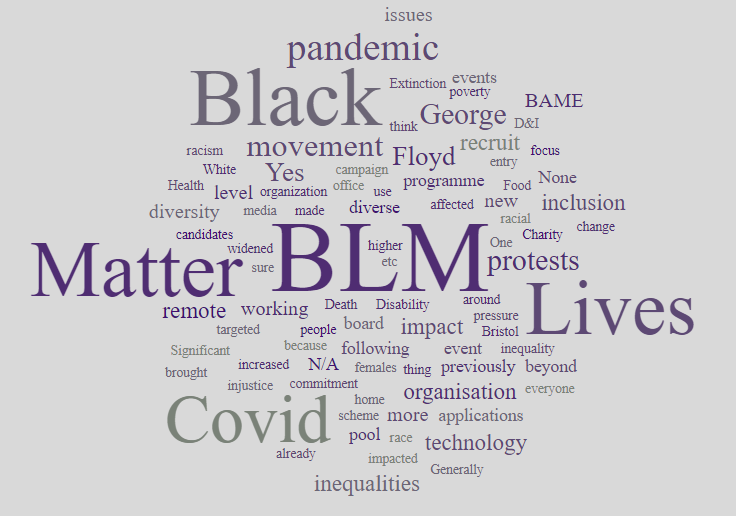
But this was not the biggest impact 2020 had on attitudes to diversity, equity and inclusion, with the killing of George Floyd that amplified the Black Lives Matter movement worldwide having a profound influence on our participants’ responses and attitudes, as you can see above by the number of references to ‘BLM’ and associated terms.
While it’s deplorable that such an event needed to happen to initiate change in some quarters, what is encouraging is that when asked about their organisation’s focus for 2021, there is a direct correlation between this movement and the steps that organisations in the charity sector are taking to address racial inequalities, with 2/3 of all respondents believing that their charity was now focusing on ‘ethnicity’ in terms of diversity, equity and inclusion. Promisingly as well, nearly 9/10 respondents were aware of the respective areas that their charities were focusing on, suggesting that the messaging internally around these issues was getting through to staff.
Charity DEI focus in 2021 (%)
Chart showcasing that 66% said ethnicity, 39% disability, 33% gender, 25% LGBTQ+ and 20% age.
Attracting new staff
One thing that was abundantly clear from the research was the importance of diversity, equity and inclusion on the decision-making process by individuals about their employer of choice.
Of those looking for a new role at the time of asking, two-thirds (2/3) of them said that an organisation’s approach to diversity, equity and inclusion was ‘very important’. This brings into focus not only the importance of it as part of an employer brand, but the value it holds for both attracting and retaining the best candidates as well.
Importance of DEI to those looking for a new role (%)
Pie chart showing that two thirds of those looking for a new role regard it as very important, one sixth as important, one twelth as not important and one twelth as not important at all.
In fact, only 5% of all participants surveyed didn’t believe an organisation’s approach to diversity, equity and inclusion was important or very important when looking for a new job, again showing how necessary a priority it should be for employers in the charity sector.
The potential impact of increased diversity, equity and inclusion in the charity sector
The charity sector is perhaps not as representative of society as it should be, but the results from our survey show that attitudes are improving to the benefits of increased diversity, equity and inclusion in the sector – in turn creating a better reflection of society with it.
When asked the biggest impact that increased diversity, equity and inclusion could have on a workplace, just under 1/3 of all respondents said that ‘greater opportunities for those that have been traditionally excluded’ would be the biggest benefit. Interestingly, the responses were more varied among hiring managers and business decision makers, with attributes like ‘culture’, ‘creativity’ and ‘productivity’ scoring highly among the Executives surveyed. This suggests change at the highest level in organisations, with business leaders believing that increased diversity, equity and inclusion would foster an altogether better atmosphere and improved business performance.
Biggest benefit of increased DEI in the workplace (Executive only) (%)
Culture (at 39%), better opportunities for those traditionally excluded (25%) and creativity (17%) were the highest rated responses in relation to the biggest benefit of increased DEI in the workplace.
At Prospectus, we believe our impact is through people. As part of this we champion diversity, equity and inclusion in all of the placements we make and with all clients that we work with. Our latest published figures with regard to diversity, equity and inclusion in our placements can be found here.
We believe that inclusion should be the norm; it is both a social justice and an organisational issue, and is intrinsic to Prospectus’ own values of collaboration, community and trust. We see every day that when diversity is truly embraced and celebrated, it unleashes tremendous creativity and value for individuals, organisations and communities, with diversity of thought at the heart of this. Contact us below to speak to one of the team about improving diversity, equity and inclusion in your own organisation.