
Over the past two years, the way candidates apply for roles has changed significantly. For many hiring managers across the not-for-profit sector, this shift will feel familiar.
Applications are arriving more quickly, in greater volumes, and are often more polished than ever. While this may appear positive at first glance, the reality is more nuanced. A growing proportion of applications are well-presented but lack genuine alignment with the role. Candidates whose experience, skills or sector understanding do not meet the requirements, despite strong written responses.
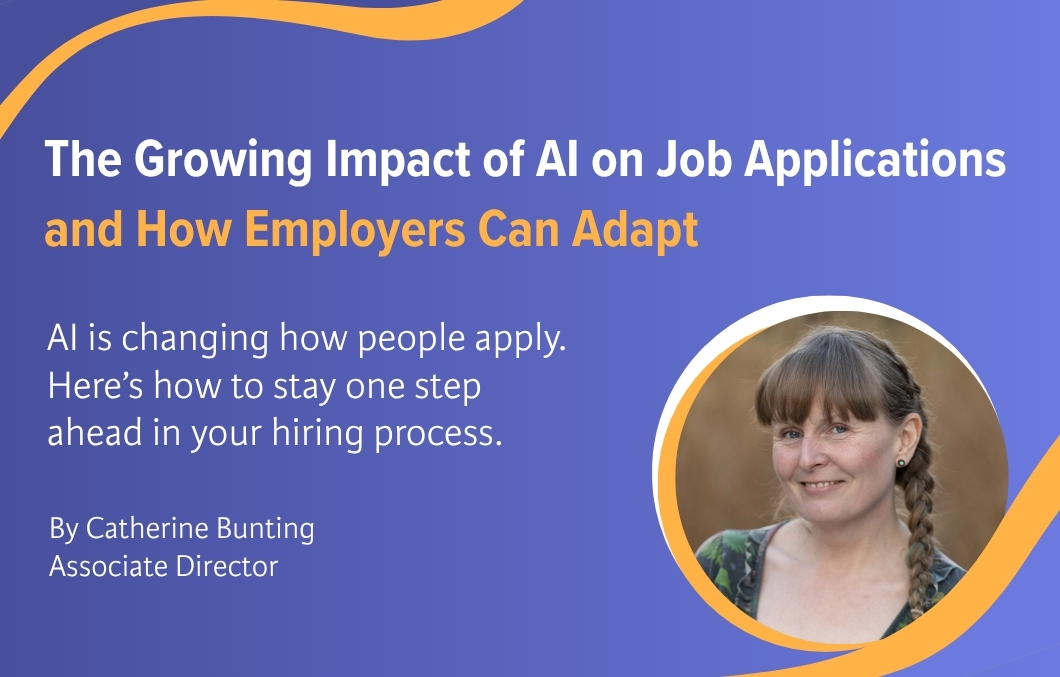
As specialist recruiters working with charities and purpose-driven organisations, we are seeing the growing impact of AI-assisted applications on recruitment processes. In this article, I want to share what we’re seeing on the ground, why it matters, and what you can do to keep your recruitment process both effective and manageable.

AI tools have made it significantly easier for candidates to produce written applications at scale.
Research from Prospects Luminate (2026) found that:
- 57% of graduates have used AI to edit a CV or cover letter
- 46% have used it to generate one from scratch
- 33% have used it to answer application questions
In addition, one in five of these job seekers reported submitting more than 100 applications, enabled largely by how easy AI makes the drafting process.
Whilst the impact of this behaviour is seen in the oversaturated graduate market (we’ll talk about the impact of AI on entry-level roles another time), we are increasingly seeing the same patterns across a broad range of roles and levels of seniority.
The most immediate consequence is a significant increase in application volume, without a corresponding improvement in candidate quality.
One recent example illustrates this clearly. An environmental research organisation we supported was forced to close a senior strategy role after just three days. Not because they had identified a suitable candidate, but because the volume of applications had become unmanageable.
On closer review, many of these applications shared similar characteristics:
- They’re high-quality written responses
- Limited alignment between claimed experience and role requirements
- A lack of clear understanding of the organisation or position
The result is a recruitment process that becomes increasingly difficult to navigate, often requiring shortlists to be revisited or processes to be restarted entirely.
It would be easy to frame this as simply an administrative headache, but the real costs can run deeper.
Reviewing large volumes of unsuitable applications requires time and resource. Both of which are often limited within charities and not-for-profit organisations. Recruitment responsibilities frequently sit alongside already demanding roles, and capacity is already stretched.
Then there’s the wider organisational effect. In most cases, roles aren’t ‘nice to have’, they’re essential. Every week a vacancy remains unfilled puts additional pressure on existing staff. Teams are stretched, workloads increase, and the knock-on effects on morale and retention can truly be felt. Re-running a recruitment process once is frustrating. Re-running it two or three times because each round produces the same poor-quality applications is genuinely damaging.
How Employers Can Adapt to AI-Assisted Applications:
While there is no quick fix, there are practical steps that can help mitigate the impact.
1. Set clear expectations from the start
Publishing explicit guidance to candidates on acceptable use of AI is one of the simplest and most impactful things an employer can do.
This does not require banning AI entirely (more on that below), but it does mean being transparent about what you expect from candidates, which can be supported by an AI policy. Setting clear expectations signals that applications will be assessed carefully and encourages candidates to submit more considered responses. It also provides a fair basis for challenging applications that do not meet these expectations. We’ve published guidance for candidates ourselves and encourage our clients to do the same.
2. Design your application process to require genuine engagement
Generic application forms with open-ended questions are particularly vulnerable to AI-generated responses. To counter this, you could consider asking candidates to:
- Draw on specific, evidence-based examples
- Reference your organisation’s work or strategic priorities
- Respond to realistic, role-relevant scenarios that would be difficult to answer plausibly without sector knowledge
These small changes make it much harder to rely on AI alone and much easier to identify candidates who truly understand your work.
3. Take a balanced approach to AI use
It is important to recognise that AI can also play a legitimate and supportive role in the application process.
Some candidates, including those with disabilities or communication differences, may rely on AI tools in the same way others rely on spell-check or grammar tools, as a means of ensuring their skills and experience are represented fairly, not as a way of misrepresenting their suitability.
Any approach to AI in recruitment should be developed with this in mind and ideally reviewed alongside your existing accessibility and inclusion commitments.
4. Consider the value of specialist recruitment support
In an environment where application volumes are increasing, a more proactive approach to recruitment can be particularly beneficial.
Working with a specialist recruiter who understands your sector and the specific demand of the role shifts the process from reactive, to proactive. Rather than filtering large volumes of applications, you benefit from:
- Proactive, targeted sourcing of relevant candidates
- Pre-screening based on sector knowledge
- Access to established networks
As well as reducing the time-to-hire, the overall cost of a well-managed recruitment process is almost always lower than the cost of running multiple unsuccessful ones.
The rise of AI-assisted applications is unlikely to go away. The tools are evolving quickly, and candidates are becoming more confident using them.
However, what you can control is your own recruitment processes – how roles are defined, how candidates are assessed, and how expectations are communicated.
For many hiring teams, this will require some adjustment, but it’s also an opportunity to build more robust, thoughtful recruitment practices.
If your most recent recruitment process felt more challenging than it should have been, is this already affecting you?
We are always happy to share what we’re seeing across the not-for-profit sector and discuss how these changes may affect your organisation in practice.