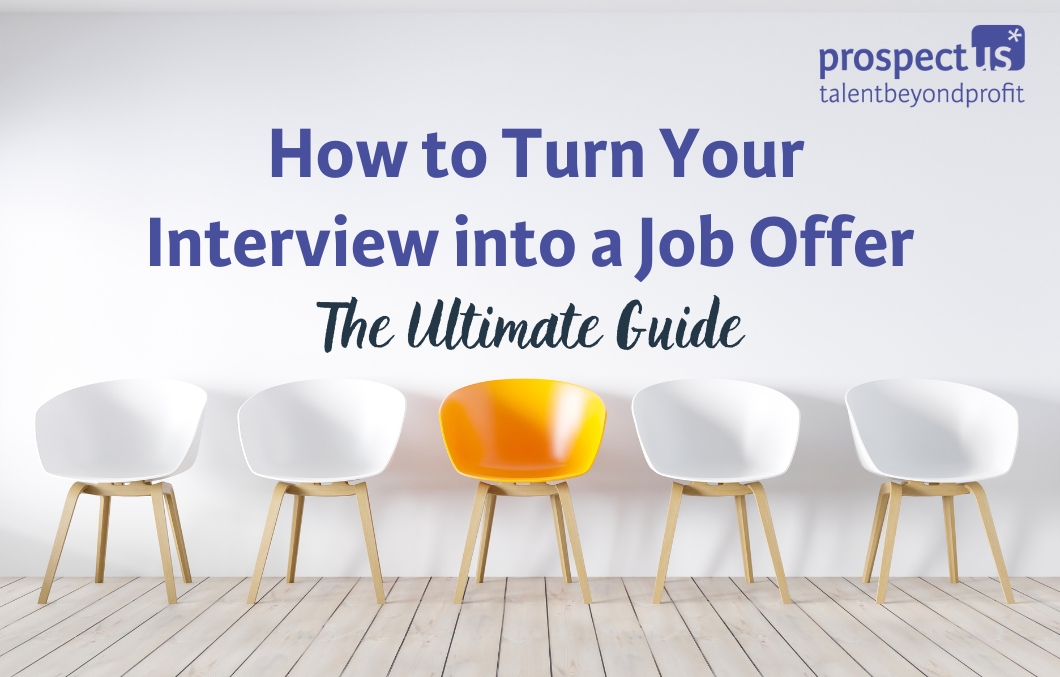

You’ve made it to the interview! The organisation read your application and thinks you can do the role on paper. Now it is the opportunity to bring your experience to life and ensure they bring you through to the next round and make you a job offer.
At the interview, it’s important to keep your calm and stand out amongst the crowd. But that can be easier said than done. Coming to the interview calm, prepared and focused will give you a strong chance of success. Our Associate Director – Recruitment, Matt Till, has provided some advice to consider when going into the interview so you can present at your best.

Preparing for the Questions
At Prospectus, we are seeing more and more organisations release information about the interview in advance. This could be sending candidates the areas they will cover with the questions, through to sending all interview questions 24 hours before the interview. This is brilliant to help you prepare for the day and put your best case forward. If the organisation is not doing this, don’t despair. Focus on the role profile, what the role entails and the experience they want. There can only realistically be around 8 – 10 questions asked at an interview. Review the personal specification and align your answers to each area. When you’re in the interview, you can quickly pull from your prepared answers.

Reflect on Your Approach
Understanding how you interview is essential. Identifying your strengths and weaknesses allows you to improve and increase your chances of receiving a job offer. It also gives you the ability to manage any challenging behaviours that may arise. For instance, I tend to speak too fast, especially in high-pressure situations like interviews. To manage this, I always have a glass of water on hand to create a pause that allows me to reset, slow down, and calm my nerves. By anticipating and preparing for your challenges, you can effectively overcome them and present yourself in the best possible light.

Impact, Impact, Impact!
We always recommend our candidates utilise the STAR method when answering questions during interviews. The STAR method stands for Situation, Task, Action and Result.
- Situation – Where were you working and what was your role
- Task – What was the issue or problem you were trying to address
- Action – What did you do to address the issue
- Result – What was the outcome or impact of that work
Candidates tend to do a great job in the first three areas but lose steam by the time they get to the result part. Here is an example for context:
“When I was working for ‘the Charity’, I was responsible for the external communication of their work. We noticed we had good traction with most demographics of supporters, but one area we struggled with building engagement with was younger people. We wanted to grow this area for support with our work, so I built out our social media presence on a range of different platforms that younger people engage with to help develop support from this demographic.”
This answer is missing the additional line to highlight the impact and result of your actions. You can see below how including the outcome, you can really heighten your answer and round it off neatly and assertively.
“…by utilising platforms X & Y, we increased our reach to this demographic by 150% over a 3-month period, with engagement continuing to grow at higher rates.”

Give One Answer
People fall into one of two major camps when interviewing – they either talk too much or talk too little. When talking too much, interviewers can be concerned about whether they will get through all the questions. When talking too little, they may not get what they need out of the answer. Those who talk too much tend to give as many examples as possible to demonstrate how much experience they have. However, not only is this time-consuming, but can be unconcise, too.
When responding to a question during an interview, give one answer – your best one! Offer your best response initially, and then offer to provide additional examples if needed. This approach allows the interviewer to guide the conversation and ensures that they have the information they require. By concluding your answer with the impact you delivered, you can naturally bring your response to a close. This strategy is particularly useful for questions where you may be uncertain if your initial answer aligns with what the interviewer is seeking.

Your Questions
At the end of the interview, there will be an opportunity for questions. This is your chance to gain further insight into the organisation, the position, the team and the overall culture. By taking advantage of this time, you can acquire the necessary information to make an informed decision regarding your next move.
Asking thoughtful questions during a panel interview is an effective way to gain insight into the panel’s perspective on the role at hand. For instance, inquiring about the greatest challenge they foresee in the position or what success would entail within the initial six months can prompt them to delve deeper into their expectations. Moreover, posing such questions provides you with an opportunity to elaborate on your relevant experience.
For example, if the panel identifies engaging external partners as a significant challenge, you could share a past experience where you successfully navigated a similar obstacle. This not only showcases your problem-solving skills but also demonstrates your ability to address challenges head-on. By engaging in meaningful dialogue through well-crafted questions, you can effectively convey your qualifications and suitability for the role.
One of the most frustrating experiences is not being selected for a role despite having the necessary experience, especially when you were not able to discuss this during the interview. However, the questions posed at the end of the interview provide a final, valuable opportunity. Questions such as “Is there anything I have not covered today that I would need to for you to make a decision?” offer a final chance to clarify any misunderstandings or provide additional information. By taking advantage of this opportunity, you can confidently leave the interview knowing that you have done everything possible to present yourself in the best light.

Follow up
If you have any logistical questions, such as the next steps in the process, the timeline for hearing back, or details about the benefits package for the position, it is best to address these in a follow-up email to your point of contact. They will be able to provide you with the necessary information and it also gives you the opportunity to express gratitude to them and the panel for their time. This approach demonstrates courtesy and professionalism.
Final Thoughts to Consider
- You are interviewing them as much as they are interviewing you. You need to ensure this is the right organisation and role for you and just because you are at the interview, doesn’t mean you’re have to take the job.
- They wouldn’t waste your time. Interviews are stressful for the candidate, but they are also a period of pain for the organisation. They wouldn’t waste your time and they really wouldn’t waste their own. You are there for a reason and they’ve invited you because they think you can do the role. Now go and show them you can!
- Enjoy it! These are your new colleagues, the people you will be spending a lot of time with. Try and enjoy it as much as you can and it will hopefully be a good experience for everyone involved.
- If you get the interview, you can get the job! As mentioned at the beginning, they wouldn’t bring you to an interview if they didn’t think you could do the job. Make sure to give it your best and ask the right questions at the end.
Everyone interviews in their own way and aligning that style can be hard. If you want to talk about your interview approach and explore areas you might need to improve on, please don’t hesitate to reach out.
You can view our latest vacancies available in senior management roles on our job board here. Do get in touch if you’d like to discuss your career further with me via Matt.Till@prospect-us.co.uk or 02074054999.