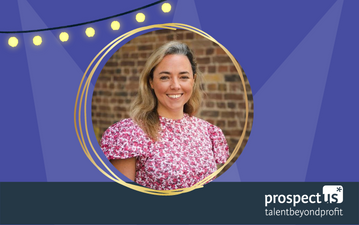

Welcome to our charity job spotlight series, where we shine a light on people and their great work in the charity sector. The series covers why they work in the sector; what their job involves; and career advice for those looking to either come into the sector or progress in their career.
Why have you chosen to work in HR within the charity sector?
I finished university and secured my first role within the HR team of a corporate law firm. I spent 4 and a half years there and learnt so much. I worked with a brilliant team and had two very inspiring managers. This was all extremely valuable in setting myself up for a long-term career in HR. However, I had always felt that I wanted to dedicate my profession to giving back to society in some form, and therefore I always felt a kind of gravitational pull to the not-for-profit sector – my personal background and the voluntary work that I had done while at university all fed into this. I made the change to the charity sector in 2019 and have never looked back. The work I do now is so incredibly rewarding and I feel extremely lucky to be part of an organisation that uses its resources to affect such positive change. I feel privileged to be one of the key people in ensuring that the organisation is doing all that it can to support its staff in delivering such amazing work.
What skills have you learnt in your career that have proven to be the most valuable?
Communication, empathy and professionalism are all skills that I have learned through my experience to date, and that I believe are extremely valuable in the HR profession.
Effective communication, and being very in-tune with the kind of communication needed in varying situations is extremely important because all situations are relative and it is important to be able to flex in your communication style in order to effectively manage or deliver on a certain task, project or scenario.
Empathy is another quality that I think is very important because there needs to be a constant awareness that we are all human, and that the human element must not be lost within the HR function. This is especially true for the home-working/hybrid model of working that many workplaces are now adopting because that genuine human touch can often feel a little bit lost and so it is key as a HR professional that you uphold this and continually strive for a workplace that feels connected, supported and engaged.
Finally, professionalism is a skill that I think is of great importance when working in HR, for all levels of seniority. Often in HR, you will be faced with challenging situations where emotions can often run high and one thing that I have learned over time is, that no matter the situation, it is important to remain calm and to carefully think about each situation before responding. Even if you are dealing with an emotionally-charged situation, it is better to relay accurate advice that you have gone away and checked, rather than giving advice in a fluster that may not necessarily be correct or in line with your organisation’s policy. Taking a professional approach to each situation also mitigates future risk, even though the situation at the time may feel particularly challenging.
What did you personally find as the biggest challenges when making that step up into the HR and Organisational Development Manager role?
Having the confidence in my expertise to relay my thoughts, recommendations and ideas to senior members of the organisation i.e. SLT and Trustees. In previous more junior roles, my responsibilities were more supportive in nature and my work product often went through a process, and reached other members of the team, before reaching SLT or Trustees for review. I still often have to remind myself of my ability and capabilities when doubt starts to creep in.
My experience to date has proven to me that confidence is a journey and not a destination because I am constantly developing and learning new things. However, as a matter of self-reflection and development, I continually work on placing trust in my ability as a HR professional and the value that I bring within my organisation.
What is your proudest achievement?
Delivering a successful organisation-wide Wellbeing Programme that made our staff feel ‘cared for’ when the country went in to lockdown in 2020. It was crucial that we demonstrated the organisation’s care, kindness, compassion and understanding for its staff throughout such a difficult time. The programme included things such as online yoga, mindfulness sessions, Microsoft Teams topical chats, mental health training, resilience workshops and line management training. I received great feedback from staff, who reported their great appreciation for these initiatives and how useful and helpful they had been. Being able to lead and deliver on this would certainly be one of my greatest professional achievements to date.
What advice would you give to anyone looking to make the move into their first senior leadership role?
My two key pieces of advice would be to first, really work on building strong relationships with colleagues and key stakeholders to gain their trust and respect, and secondly, to understand the organisation.
I would consider both of these points to be absolutely key in succeeding within a senior leadership role. There are of course numerous merits to building strong relationships, the most obvious one being that it is simply nice to have good relationships with those around you, but from my experience, those strong relationships have really helped with building collegiality and the confidence that others have in your work product.
Understanding the organisation is also essential in being successful within a senior HR role because there has to be that understanding in order to align the people function with it. If a HR professional does not understand the work the organisation does, its strategy, how each team works, the values and goals of the organisation, the historical context etc., then this prohibits the HR function from adding true value.
Thanks so much for taking the time to speak with us Holly.
If you would like to learn more about our work in the sector or would like to be featured in our series, you can contact us here.